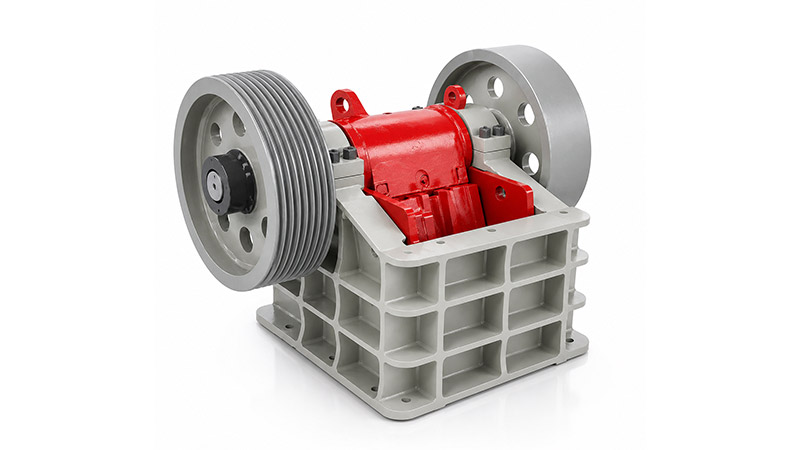
PE Jaw Crusher Overview
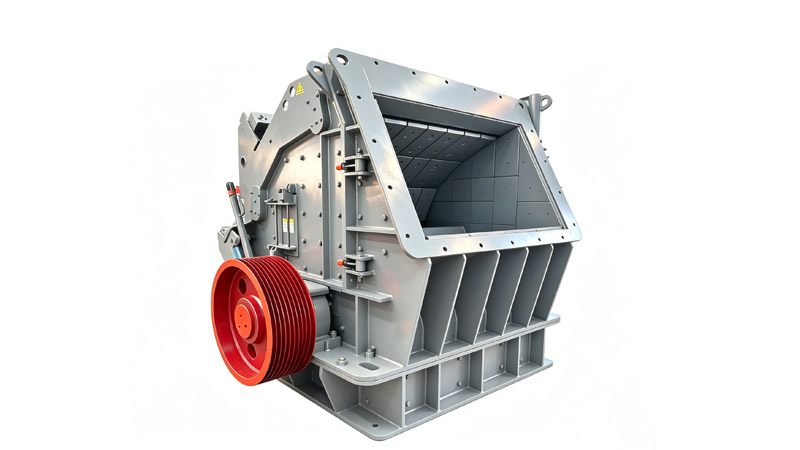
The PE jaw crusher is the workhorse primary crusher for the toughest hard-rock duty. With a deep V-shaped crushing chamber and a heavy-duty cast steel moving jaw assembly, it delivers a large feed opening, a high reduction ratio, and consistently high throughput in aggregate, mining, and construction recycling plants. The eccentric shaft runs on heavy-duty bearings with a robust frame design that absorbs shock loads, so the machine stays stable even when fed with oversized boulders.
Maintenance is a strong point of the PE series: the toggle plate acts as a mechanical fuse that protects the frame from uncrushable material, and wear parts such as the fixed and movable jaw plates are quick to replace. An optional hydraulic discharge opening adjustment makes gap setting a matter of minutes rather than hours.
Key Features
- Deep crushing chamber — large feed capacity and high throughput
- Cast steel moving jaw assembly — high structural strength under peak load
- Heavy-duty eccentric shaft and oversized bearings — stable, low-vibration operation
- Hydraulic discharge opening adjustment — fast gap setting (optional)
- Tramp-iron protection via toggle plate — prevents frame damage
- Complete crushing cavity series from PE400x600 to PE1500x1800
Typical Applications
The PE jaw crusher is used as the primary stage for granite, basalt, limestone, river stone, iron ore, and construction waste. Typical layouts include jaw-to-cone lines for aggregate production, jaw-to-impact lines for softer materials, and jaw-to-grinding circuits in ore processing plants. Models from PE400x600 to PE1500x1800 cover capacities from roughly 15 t/h up to 800-1100 t/h, matching medium quarries up to large mining operations.
How to Choose a Jaw Crusher
Selection is driven by feed size, raw material hardness, and target capacity. As a rule of thumb, the feed opening should accept the largest boulder you will feed (usually 80% of the opening dimension), and the required capacity should sit in the middle of the model's range rather than at the limit. For abrasive ores such as granite or iron ore, prefer a heavier-duty model with a larger eccentric throw; for limestone and recycled concrete, standard configurations are sufficient.
FAQ
Q: What is the difference between PE and PEX series? A: PE series is designed for primary crushing with a large feed opening, while PEX series is a secondary/fine jaw crusher with a smaller feed size and finer discharge range. Q: How often should jaw plates be replaced? A: Typically every 6-12 months depending on abrasiveness; inspect weekly for wear and rotate/replace when the tooth profile loses bite. Q: Can the PE jaw crusher handle wet or sticky material? A: Not ideally — sticky fines tend to build up in the crushing chamber; pre-screening the feed is recommended for high-clay materials.