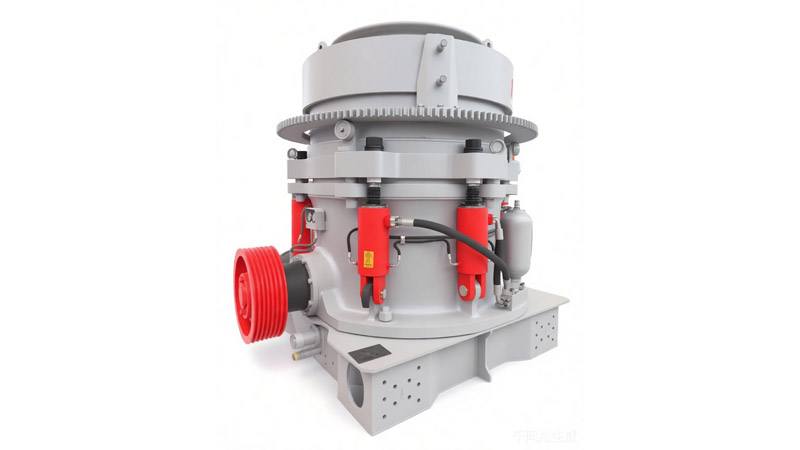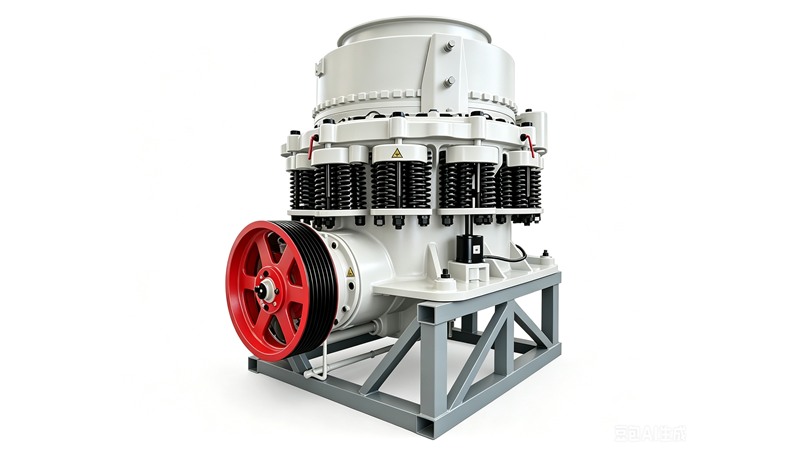
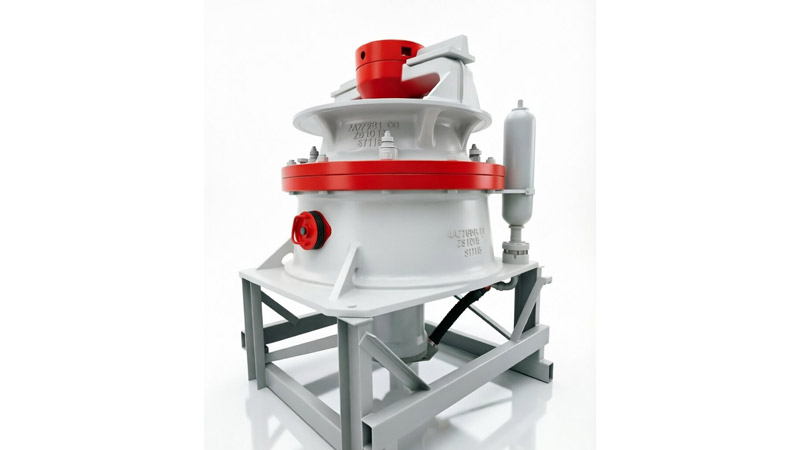
Single Cylinder Hydraulic Cone Crusher Overview
The single cylinder hydraulic cone crusher combines crushing, hydraulic adjustment, and tramp-iron protection in one integrated system, making it one of the most cost-effective secondary and tertiary crushers on the market. Its top-and-bottom supported main shaft provides exceptional load capacity, while the laminating crushing principle produces cubical, well-shaped aggregate with a low content of flat and elongated particles.
Unlike spring cone crushers that require manual gap adjustment, the single-cylinder design lets the operator set the discharge opening from the control panel in seconds. When uncrushable material enters the chamber, the hydraulic system releases the bowl instantly and returns to the set position automatically — no downtime, no manual clearing.
Key Features
- Integrated hydraulic system — adjustment and overload protection combined
- Laminating crushing principle — excellent, uniform particle shape
- Top-and-bottom main shaft support — strong load capacity, less stress concentration
- Fully automatic operation — optional PLC control with remote monitoring
- Low profile design — ideal for fixed and mobile plants with height constraints
- CS420, CH420, CS430, CH430, CS440, CH440, CS660, CH660 model coverage (90-315 kW)
Typical Applications
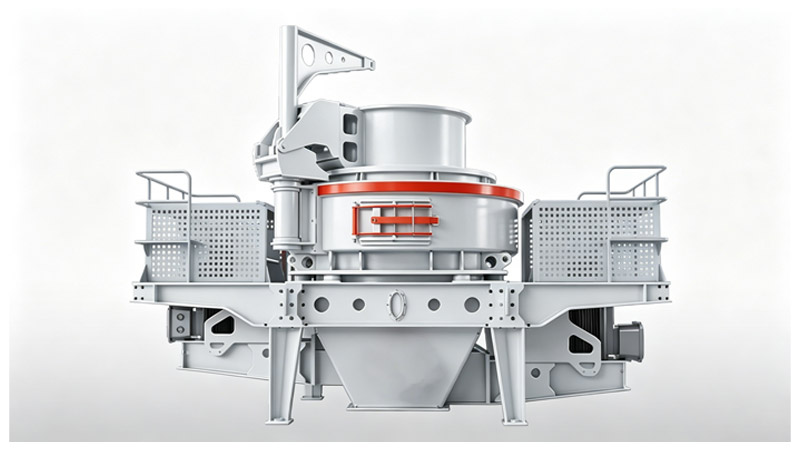
This crusher excels as the secondary or tertiary stage in granite, basalt, and iron ore circuits. In aggregate plants it feeds directly to a VSI or tertiary crusher; in mining operations it prepares ore for the ball mill or SAG circuit. The fine-cavity (CH) variants are used for tight discharge settings down to 4-16 mm, while coarse-cavity (CS) variants maximize secondary-stage throughput up to 200-450 mm feed.
Selection and Operation Tips
Match the cavity type to the application: CS (coarse) chambers for secondary crushing, CH (fine) chambers for tertiary or pebble crushing. Keep the feed evenly distributed and continuously choked — a trickle feed produces poor particle shape and wastes energy. The automatic overload release means operators should set the maximum hydraulic pressure correctly per the manual; setting it too high removes the tramp-iron protection.
FAQ
Q: What maintenance does the hydraulic system need? A: Check oil level and filter monthly, replace hydraulic oil annually, and inspect seals for leaks during routine service. Q: How do I improve particle shape? A: Use the fine cavity, keep the chamber choke-fed, and consider running the closed side setting tighter — laminating requires a full chamber. Q: What is the difference from the multi-cylinder type? A: The single-cylinder design uses one hydraulic cylinder for both adjustment and protection with a simpler, more compact structure; the multi-cylinder type offers faster adjustment response and higher crushing force for the hardest ores.