VSI Vertical Shaft Impact Crusher Overview
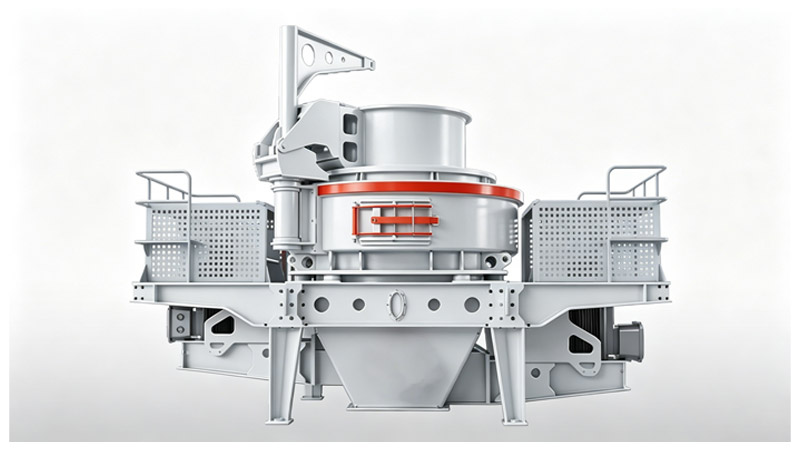
The VSI (Vertical Shaft Impact) crusher is the specialist machine for manufactured sand and aggregate shaping. It uses a high-speed rotor to accelerate rock against either a rock bed (rock-on-rock) or a metal anvil ring (rock-on-iron), generating the high-energy impacts that fracture particles along natural grain boundaries. The result is cubical, well-graded sand and aggregates with an excellent particle shape that concrete and asphalt producers demand.
Modern VSI designs offer a dual-mode operation: rock-on-rock for maximum product quality on abrasive materials, and rock-on-iron for higher throughput on less abrasive feed. The deep-cavity rotor and hydraulic opening simplify maintenance, and wear parts can be rotated or replaced quickly to balance wear.
Key Features
- Rock-on-rock and rock-on-iron dual crushing modes
- Deep cavity rotor — high throughput and efficient energy transfer
- Excellent finished sand particle shape — cubical, low dust content
- Hydraulic opening — quick access for rotor and anvil maintenance
- Automatic cascade control for consistent sand grading
- Critical for manufactured sand: meets concrete sand grading requirements
Typical Applications
The VSI crusher is the core machine in manufactured sand plants, shaping and shaping-crushing circuits, and pre-grinding operations in cement plants. It converts surplus coarse aggregate from cone crushers into premium cubical sand, and it improves the shape of crushed stone for asphalt and railway ballast. VSI is also used in the iron ore industry to increase the amount of ore that can be fed to concentration circuits.
Operational Tips for Sand Production
To produce concrete-grade manufactured sand, run the VSI in closed circuit with a screen, control the feed rate to keep the rotor choke-fed, and cascade a portion of the feed directly to the crushing chamber to stabilize the gradation. Monitor rotor wear indicators and rotate the rotor shoes before uneven wear develops. Keep the rotor balanced — an unbalanced rotor causes vibration and shortens bearing life.
FAQ
Q: What is the difference between rock-on-rock and rock-on-iron? A: Rock-on-rock uses a stone bed for the highest product quality and lowest metal wear on abrasive materials; rock-on-iron uses a metal anvil for higher throughput and is better for softer, less abrasive feed. Q: Why is VSI sand better than natural sand for concrete? A: VSI sand has a cubical shape, a controlled gradation, and no organic impurities — giving higher concrete strength with lower cement dosage. Q: What is cascade feed? A: Diverting part of the feed directly into the crushing chamber (bypassing the rotor) to increase throughput and stabilize the product gradation.